
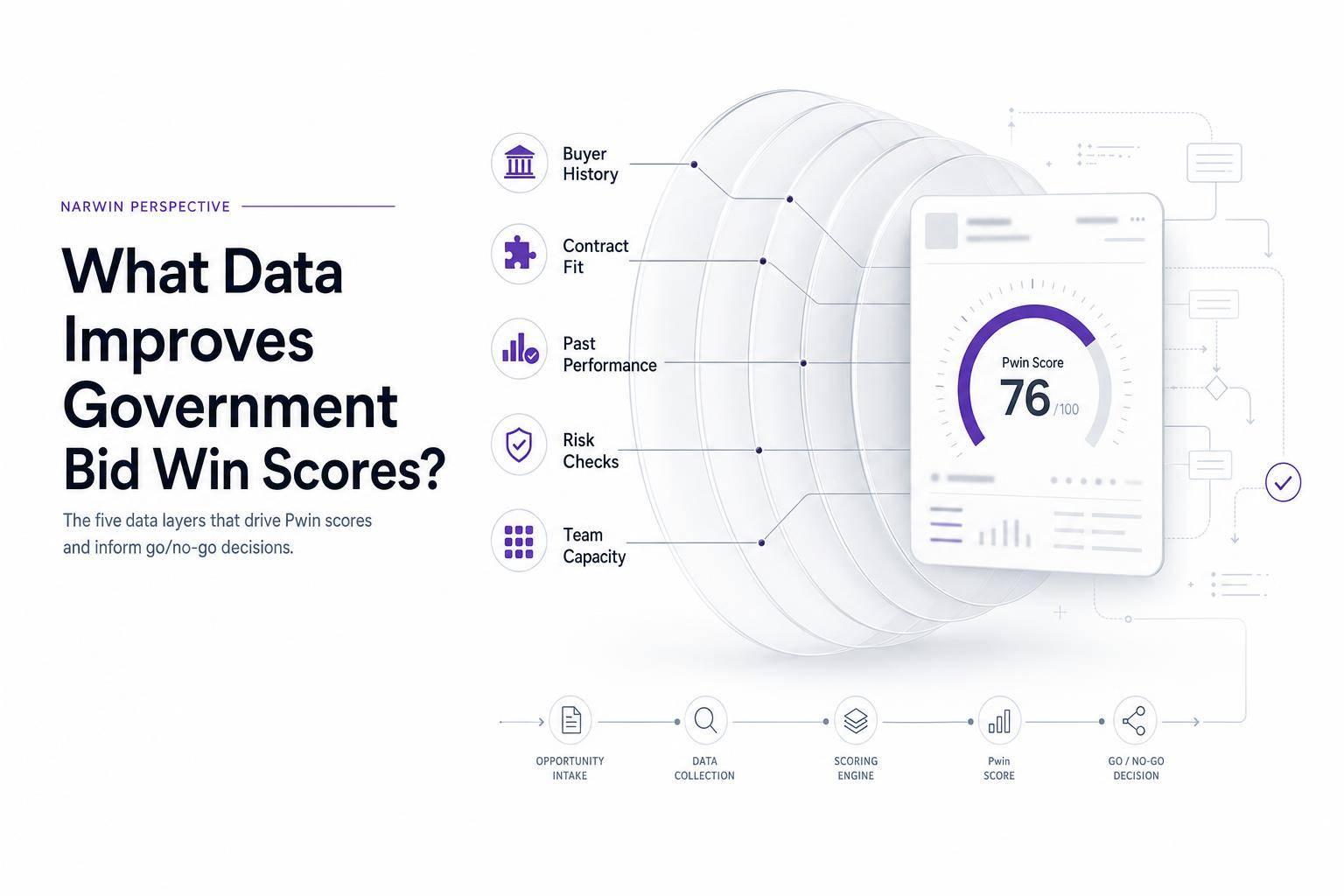
If I want a better bid win score, I need better data – not more guesswork. The inputs that move the score most are buyer history, contract fit, past performance, risk checks, and team capacity.
A government bid win score, or Pwin, is just a percent estimate of my chance to win. But the number only helps if it reflects how agencies review bids under FAR Part 15: technical approach, past performance, staffing, and price. If my records are off, my score is off too.
Here’s the short version:
- Buyer history tells me if the agency tends to stick with the incumbent or lean on price.
- Contract fit checks whether the NAICS/CPV codes and contract size match work I already do.
- Past performance looks at recent, similar jobs, including CPARS and repeat-award patterns.
- Risk items catch deal-breakers like missing certifications, weak forms, bad pricing gaps, or multiple amendments.
- Team capacity shows whether I have enough people and hours to write the bid and deliver the work.
The main point: I get a better win score when I score all five areas the same way across every bid, use hard gates for must-have requirements, and cut weak pursuits early.
That turns the score from a gut check into a simple bid/no-bid tool.
Buyer History and Contract Fit Data
Two early filters do most of the heavy lifting here: buyer history and contract fit. Before your team sinks time into proposal work, these signals can tell you if the bid is even worth chasing.
Buyer History: Incumbency, Award Patterns, and Evaluation Priorities
Start with the plainest question first: Is there an incumbent, and how long have they held the work? That matters a lot. An incumbent often has a clear edge over a new challenger offering about the same price and technical quality. If the buyer already knows the current vendor can do the job, switching takes a reason.
That said, incumbents don’t win by default. A non-incumbent can still be in the mix when the buyer is unhappy with the current vendor, when past performance scores are weak, or when the scope changes in a big way. Maybe the contract now calls for new tech, or maybe it expands into more locations. Changes like that can chip away at the incumbent’s edge and open the door for other bidders.
Then look at how the buyer scores bids. Past solicitations can show whether the buyer used a best-value tradeoff or a Lowest Price Technically Acceptable (LPTA) method. That detail changes how you should read the opportunity:
- If technical approach weighs more than price, your technical case matters more than being the cheapest.
- If the agency tends to use LPTA, price should carry much more weight in your win score.
Buyer history gives you the starting point. After that, the next step is checking whether past performance and current risk signs back up the pursuit.
Contract Value, NAICS, and CPV Alignment
If buyer history looks good, three more fit signals usually do the rest of the screening work: contract value, NAICS code, and CPV code.
Contract value gives you a read on both competition and buyer expectations. A $150,000 opportunity is not judged the same way as a $2,000,000 one. Tag each bid by value band – under $250,000, $250,000–$1,000,000, and over $1,000,000 – then stack that against your firm’s past win rates and delivery capacity at each level. If you’re bidding far above your normal project size and can’t show strong capacity, your win score should drop.
NAICS code alignment is a core fit check for U.S. bids. An exact NAICS match signals that your firm lines up with the work and meets the right size standard. A mismatch can be a red flag for both the buyer and your own scoring model, unless the scope language clearly points to the services you actually provide.
For Canadian bids, CPV codes help sharpen service fit beyond NAICS. In a win-score model, these fit signals often matter more than broad narrative claims.
Narwin.ai can surface buyer history, contract value, and NAICS/CPV fit in an early match score, which helps teams make faster go/no-go calls. If a bid makes it through these filters, the next move is to review past performance, risk items, and amendment trends.
Past Performance, Risk Items, and Amendment Signals
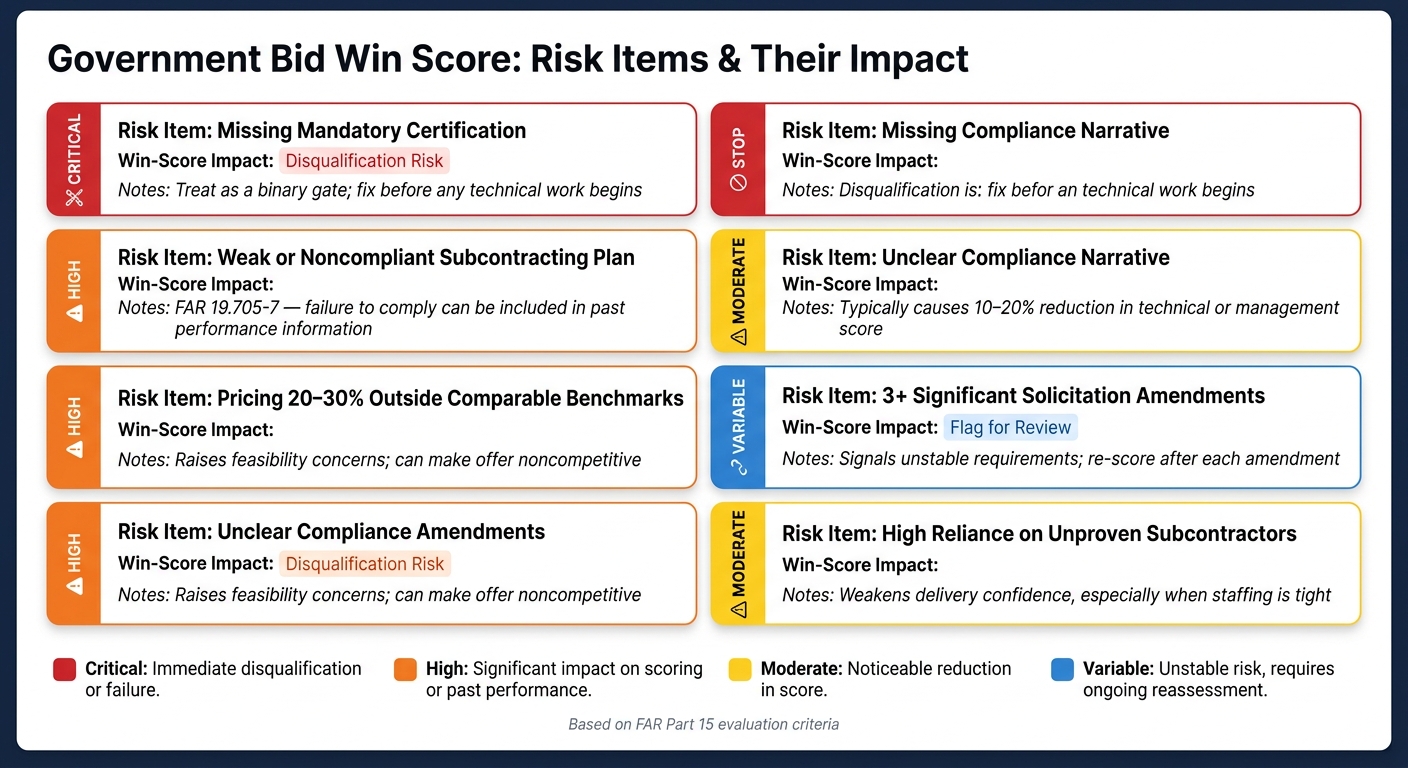
Government Bid Win Score: Risk Items & Their Impact
Past Wins and Relevant Performance Data
Fit gets you into the bid. Past performance tells evaluators if they can trust your team to deliver. Once buyer history and contract fit are in place, this becomes the next big check on delivery risk.
Under FAR 15.305, agencies look at currency, relevance, source, context, and trend. Work completed in the last 3–5 years usually matters more than older contracts. And not all references carry the same weight. A larger contract with the same agency, similar scope, and a matching NAICS will mean more than a vaguely related project from years ago.
For U.S. federal work, CPARS ratings are the clearest structured signal. Ratings of "Very Good" or "Exceptional" across quality, schedule, cost control, and management can strengthen a win score in a meaningful way. It also helps to track contract renewal rate and repeat-award rate. Those numbers give you a plain read on whether buyers came back for more.
Same-agency references should count more heavily. And when you’re scoring references, focus on relevance, not volume. A short list of tight matches beats a long list of maybes. Look at:
- Technical similarity
- Scope overlap
- Contract value
- Contract type
- Performance context
Use references that line up cleanly with the current effort. If the match feels forced, evaluators will notice.
Compliance Gaps, Pricing Risk, and Amendment Trends
Strong past performance won’t rescue a proposal that trips over compliance. In many cases, the proposal gets screened out before anyone reads the technical approach.
Common problems include missing or expired certifications, incomplete reps and certs, errors in required forms, or a subcontracting plan that misses mandated targets. Any one of these can lead to disqualification.
Pricing can also create risk fast. If your offer lands 20%–30% outside similar benchmarks, evaluators may question whether you understand the scope. If the price is too high, the proposal can become noncompetitive even when the technical plan looks solid.
Amendments are another signal worth watching closely. When a solicitation goes through three or more significant amendments – especially changes to the statement of work, evaluation criteria, or deadline extensions – the requirement may still be shifting. That should trigger a fresh alignment check every time. If your proposal misses a material amendment, that’s not a small typo-type issue. It can turn into a major compliance failure and add contract-delivery risk.
| Risk Item | Win-Score Impact | Notes |
|---|---|---|
| Missing mandatory certification | Critical – disqualification risk | Treat as a binary gate; fix before any technical work begins |
| Weak or noncompliant subcontracting plan | High | FAR 19.705-7 allows a failure to make a good-faith effort to comply to be included in past performance information |
| Pricing 20%–30% outside comparable benchmarks | High | Raises feasibility concerns and can make the offer noncompetitive |
| Unclear compliance narrative | Moderate | Typically warrants a 10–20% reduction in the technical or management score |
| 3+ significant solicitation amendments | Variable – flag for review | Signals unstable requirements; re-score after each amendment |
| High reliance on unproven subcontractors | Moderate | Weakens delivery confidence, especially when staffing is already tight |
Narwin.ai can scan solicitation documents to flag compliance gaps, point out pricing risk signals, and track amendment history as a live input to your win score. That gives your team the current picture of the opportunity before you spend time and budget on a proposal.
If these checks pass, the next question is whether the team has the capacity to deliver.
sbb-itb-bb3960c
Proposal Team Capacity and How to Build a Win Score
Team Availability, Key Personnel, and Delivery Capacity
After compliance and risk checks, capacity is the last internal go/no-go filter. You can have a strong match with the buyer, but that stops mattering fast if the team can’t deliver.
A simple way to measure this is with utilization rate: the share of each person’s time that’s already booked. When the team sits in a healthy range, it can take on a major bid without hurting quality. At a stretched level, things start to slip. Technical sections lose depth, pricing gets rushed, and past performance writeups turn generic. At overloaded, the bid should be downgraded or dropped.
Set minimum hours for each key role during the proposal window. If those hours aren’t available, lower the score or mark it no-bid.
Key personnel fit matters just as much. Match each proposed resume straight to the RFP’s mandatory and rated requirements: years of experience, domain expertise, certifications, and any agency-specific criteria. If the proposed project manager only partly meets the experience threshold or is missing a required certification, the technical score will take a hit even when the solution itself is strong.
As staffing gets tighter, the capacity score should fall. A fully staffed team keeps the score in line with outside strengths. A partly staffed team drags down a strong shot. An overstretched team can turn even a high-fit bid into a likely no-bid.
Delivery readiness goes past the proposal stage too. If winning one more contract would push field teams or project managers above safe workload limits, delivery risk goes up and the win score should drop with it.
Use the capacity score as a gate before you roll everything into the composite model.
Building a Practical Win-Score Model with AI
A solid win-score model brings together all the data covered in this article: buyer history, contract value, NAICS/CPV fit, past performance, risk items, amendment trends, and team capacity. Put the most weight on buyer history, past performance, and capacity. Treat mandatory requirements as hard gates. Capacity also needs enough weight to act like a real limiter, because weak internal execution can wipe out strong outside conditions.
Narwin.ai can combine public tender signals – from sources like SAM.gov, CanadaBuys, BCBid, and local portals – with internal capacity data to produce a single go/no-go score. That helps tie the score to both outside opportunity data and internal delivery reality.
Conclusion: The Data That Most Improves Bid Win Scores
Taken together, these five signals have the biggest effect on bid win scores. Scores tend to improve most when you look at buyer history, contract value, NAICS and CPV fit, past performance, risk signals, and staffing capacity as one set, not as separate checks.
When teams apply that scoring the same way across every opportunity, a useful feedback loop starts to form. Over time, the pattern becomes clearer: which buyer profiles tend to convert, and which risk signals often point to a no-go call. That kind of consistency turns win scoring into a repeatable way to make decisions instead of a gut call.
That discipline also saves time and protects proposal capacity. Faster no-bid calls free up resources for bids that are a better match.
Narwin.ai can combine public tender data with internal performance and capacity records to generate a win score for each opportunity. The result is a cleaner pipeline and better go/no-go decisions.
FAQs
How do I weight each input in a Pwin score?
Weight each input based on how much it shapes your odds of success for that opportunity.
A common model looks like this:
- Past Performance: 20%
- Technical Capability: 20%
- Pricing Position: 15%
- Agency Relationships: 15%
- Competitive Landscape: 15%
- Solution Readiness: 10%
- Compliance & Risk: 5%
If you’re scoring by hand, keep it simple. Pick 5 to 10 key criteria, assign weights that add up to 100%, and score each one on a 1-to-5 scale.
Then calculate:
pWin = (A × w1) + (B × w2) + ... + (N × wn)
When should I no-bid an opportunity?
Consider a no-bid when the win probability score falls below 50%.
Use extra care in the 30% to 49% range. That zone is risky, and it often signals that the deal may not be worth the time, cost, or internal effort. If the score drops below 30%, it will usually mean no-bid unless there’s some unusual strategic value that changes the picture.
You should also step back when the analysis shows:
- major compliance gaps
- weak competitive positioning
- poor fit with your financial or operational goals
- amendments that materially lower your win score
This is one of those moments where discipline matters. A low score on its own is a warning sign. Add compliance issues, a weak market position, or changes that hurt your odds, and the case for walking away gets much stronger.
What data should I update after an RFP amendment?
After an RFP amendment, re-run your win score and analysis right away.
Amendments and Q&A releases can shift evaluation criteria, compliance rules, or submission priorities. And that can change your odds of winning.
When you update your analysis early, you can spot those shifts before they turn into bigger problems. That gives you time to adjust your approach, tighten your response, or step back before putting in more time and money.