
If I read a Part 15 RFP the wrong way at the start, I can waste weeks of proposal work and still lose on the first submission.
Here’s the short version: I need to check Section M first, treat Sections L and M like rule text, and assume the agency may award without discussions. Under FAR 15.305, agencies must evaluate proposals only on the factors and subfactors in the solicitation. Under FAR 15.306, clarifications, communications, and discussions are not the same thing, and most of them do not let me fix major proposal gaps.
Before I commit bid time or spend $10,000+ on outside support, I should check five things:
- Are the evaluation factors and subfactors clear in Section M?
- Does the RFP say the agency may award without discussions?
- Am I writing to named factors, not guessed agency likes?
- Do I know what clarifications, communications, and discussions can and cannot fix?
- Have I written down every unclear point as a bid risk?
One hard truth drives the whole article: the initial proposal often has to stand on its own. If I miss that, my bid plan, review plan, and protest theory can all fall apart fast.
A quick side-by-side view makes the issue plain:
| Topic | Common mistake | What I should do instead |
|---|---|---|
| Evaluation factors | Write to assumed agency likes | Write only to stated factors and subfactors |
| Ratings | Chase labels like “Outstanding” | Give proof under each factor |
| Clarifications | Treat them like a fix for missing content | Use them only for narrow clerical points |
| Communications | Assume they allow proposal repair | Treat them as limited exchanges before competitive range |
| Discussions | Expect the agency to coach every weak spot | Assume only some issues may be raised |
| Award plan | Count on a second chance | Build an initial proposal that can win as submitted |
If I fix the read before go/no-go, I give the team a much better shot at aligning the proposal with the RFP and avoiding weak protest arguments later.
Misreading Evaluation Rules Under FAR 15.305
FAR 15.305(a) is plain: proposals must be evaluated only on the factors and subfactors listed in the solicitation. That’s the line evaluators have to stay inside. They can’t formally score your proposal on preferences that never showed up in Section M, no matter how well they know your company or how much they liked past work.
This is the first gut check for bid strategy. A lot of teams treat Section M like loose guidance when it’s actually the boundary. They write to what they think the agency wants instead of what the RFP says it will evaluate. That gap – between the written criteria and the team’s own read of them – is where proposals start to come apart.
Stated Factors vs. Assumed Agency Preferences
The most common mistake is simple: teams rebuild the proposal around assumed agency preferences even when Section M points somewhere else.
That usually shows up in the outline. Subfactors such as staffing plans, transition approaches, or quality control get pushed into appendices or handled in a few short paragraphs, even when they carry real scoring weight. At the same time, pages get spent on company storylines or “innovation” themes that don’t tie back to any stated factor.
The fix is blunt but effective: if Section M names it, write to it. If it doesn’t, cut it.
Use the factor and subfactor names from Section M as your proposal headings. A compliance matrix that maps each proposal section to a specific RFP reference helps keep the team on track. It also makes it much harder for assumption-driven writing to sneak in.
Rating Methods Are Not the Same as Evaluation Factors
This mistake is more subtle, but it can throw off the whole proposal plan.
Agencies use rating methods – adjectival scales like Outstanding, Good, and Acceptable, color codes, or numeric scores – to show how well a proposal meets the stated factors. But those labels are not the factors themselves.
When teams mix up the two, they start chasing an Outstanding rating instead of building detailed, proof-based responses to each factor and subfactor. That’s a problem. The proposal may end up sounding polished and full of praise, but it still won’t give evaluators what they need to justify a high rating under the actual criteria.
| FAR Text Paraphrase | Common Misread | Correct Interpretation |
|---|---|---|
| Proposals shall be evaluated solely on the factors and subfactors specified in the solicitation. | The agency has a history of preferring local vendors, so we’ll lead with our regional office. | If it is not a named factor or subfactor in Section M, it cannot be used to score the proposal. |
| Agencies may use adjectival, color, or numeric ratings for each factor. | We need to chase an Outstanding rating throughout. | Ratings are the measurement tool; the factors and subfactors are the actual subjects being measured. |
During pink or red team review, make reviewers map each major section back to a Section M factor. That same discipline should carry into exchange planning. If a reviewer can’t trace a section back to Section M fast, the outline is off.
Once the team lines up proposal content with Section M, the next check is whether the RFP leaves room for clarifications, communications, or discussions under FAR 15.306.
sbb-itb-bb3960c
Confusing Clarifications, Communications, and Discussions Under FAR 15.306
FAR 15.306 sets out three separate types of exchanges between the Government and offerors after proposals come in: clarifications under 15.306(a), communications under 15.306(b), and discussions under 15.306(d). In practice, teams often mash these together and assume they’ll get a chance to patch problems later. That’s where things go sideways. If you misread FAR 15.306, you can end up leaving issues in a proposal that never get a chance to be fixed.
Clarifications Do Not Fix Material Proposal Gaps
Clarifications are narrow exchanges used when the Government expects to award without discussions. They’re meant for small clerical cleanups, like fixing a math error or confirming an unclear date.
What they don’t do is repair major holes in a proposal. That includes missing key personnel resumes, a missing transition plan, omitted past performance references, or a technical approach that doesn’t meet the requirement. If the exchange would change a material part of price, the technical approach, or staffing, it has crossed into discussions no matter what the agency calls it. So if a team treats clarifications like a backup plan, it’s betting on something FAR Part 15 does not allow.
Once an exchange moves past clerical cleanup, the issue shifts: is it a communication or a discussion?
When Communications and Discussions Actually Matter
Communications take place before the competitive range is set. Their job is to help the Government understand the proposal, sort out past performance concerns, or decide whether the proposal could be made acceptable. They happen before the competitive range and do not give offerors a free pass to revise the proposal.
Discussions are different. They happen after the competitive range is set and they do allow proposal revisions. During discussions, the contracting officer has to point out deficiencies, significant weaknesses, and adverse past performance information that hasn’t already been addressed. But that does not mean the agency has to walk the offeror through every possible fix.
That line matters because each exchange type changes what a team can still correct. Here’s how they differ in practice:
| Exchange Type | FAR Citation | Revisions Allowed | Common Use Case | Common Misread |
|---|---|---|---|---|
| Clarifications | 15.306(a) | No; limited to minor clerical issues | Correcting a price sheet math error | Can fix missing technical content |
| Communications | 15.306(b) | No; limited to past performance or responsibility issues | Resolving adverse past performance before competitive range is set | Guarantee a cure for all non-compliance |
| Discussions | 15.306(d) | Yes; offerors may revise proposals and submit final proposal revisions | Negotiated exchanges with competitive-range offerors | Agency must coach every possible improvement |
When Section L says the Government may award without discussions, the first submission has to carry its own weight. That’s where bid risk starts.
How These Misreads Create Bid and Protest Risk
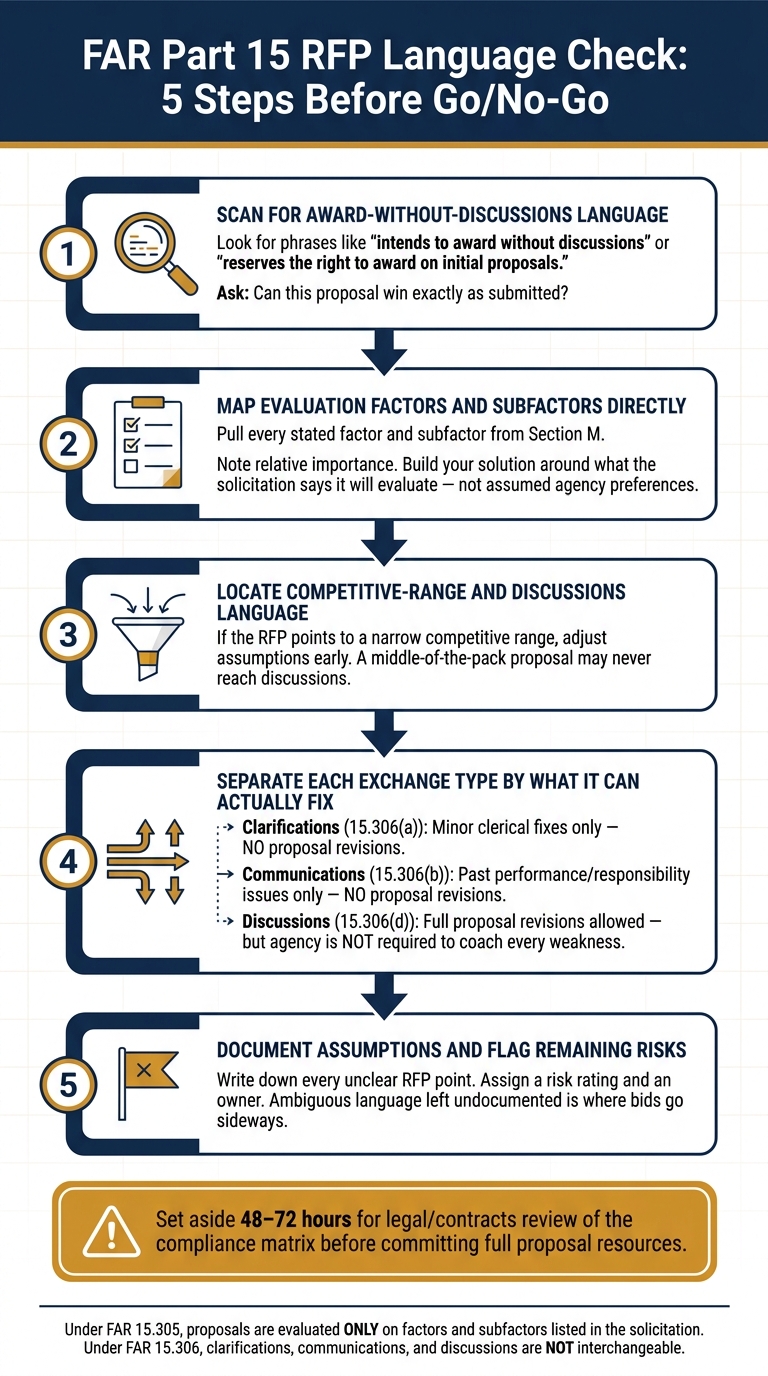
FAR Part 15 RFP Review: 5-Step Language Check Before Go/No-Go
These misreads matter because they shape both your bid posture and your protest posture. If your team misreads FAR Part 15, the problem usually shows up later – right when it hurts most. A proposal may get cut before discussions even begin, or a protest may fall apart because it leans on a bad assumption about what the agency was required to do. That’s where risk turns into a loss at award or protest stage.
For proposal teams, one mistake shows up again and again: assuming discussions will save a weak first submission. Under FAR 15.306(d), agencies must identify deficiencies, significant weaknesses, and adverse past performance not yet addressed. That’s the floor. And it’s much narrower than many teams expect.
Agencies do not have to point out every minor weakness, suggest how to move a proposal from one rating to a higher one, or walk through every evaluation subfactor. GAO has consistently held that discussions do not need to cover every possible improvement area. So when a protest argues that the agency should have provided rating coaching, it usually goes nowhere. The plain takeaway: your initial proposal needs to stand on its own.
A Language-Check Process to Run Before Go/No-Go
Before go/no-go, read the solicitation like a legal trigger document – not a marketing brief. That shift matters. The words in the RFP set the rules, and small wording choices can change your whole bid plan.
Use this check before you commit full proposal resources:
- Scan for award-without-discussions language: Look for phrases like intends to award without discussions or reserves the right to award on initial proposals. If you see that language, ask a hard question: can this proposal win exactly as submitted?
- Map evaluation factors and subfactors directly: Pull out every stated factor and subfactor, note their relative importance, and make sure your solution responds to each one. Don’t build around what you think the agency likes. Build around what the solicitation says it will evaluate.
- Locate competitive-range and discussions language: If the solicitation points to a narrow competitive range, change your assumptions early. Flag that language. A middle-of-the-pack proposal may never make it to discussions.
- After mapping evaluation and award language, separate each exchange type by what it can actually fix: Flag each place where the RFP uses the term and spell out what that exchange can fix. This keeps the team from leaning on clarifications to patch major gaps – something FAR 15.306(a) does not allow.
- Document assumptions and flag remaining risks: If the RFP is silent or unclear, write the team’s assumption down and treat it as a risk in the capture plan. That’s where bids often go sideways – not in the obvious parts, but in the things people assumed and never said out loud.
Narwin.ai can speed up this check by pulling out evaluation factors, discussion language, and award-without-discussions clauses from the solicitation.
Conclusion: Fix the Read Before You Commit to a Bid
Fix the read before go/no-go. If your team misreads FAR Part 15, that mistake doesn’t stay small. It turns into weak bid calls.
Here’s the problem: when teams assume discussions will happen, they often underfund the parts of the proposal that matter most. Then the initial proposal ends up carrying all the risk. That’s why your go/no-go checklist needs to catch FAR Part 15 mistakes before funding begins.
Corrections to Add to Every RFP Review Checklist
Use this checklist to separate what the contract says from what the bid team merely assumes.
| Checklist Item | What to Verify |
|---|---|
| Factor alignment | Every proposal section maps to a stated factor or subfactor, with no major effort spent off-factor |
| Exchange limits | The team knows what clarifications, communications, and discussions can actually fix |
| Award-without-discussions gate | The initial proposal can win exactly as submitted, regardless of whether discussions occur |
| Interpretation risk log | Ambiguous RFP language is documented with a draft interpretation, risk rating, and an assigned owner |
| Legal/contracts review | Any unusual FAR references or evaluation procedures have been reviewed by contracts or legal counsel |
Set aside 48–72 hours in the capture schedule for legal/contracts review of the compliance matrix and any unclear clauses. If that step gets skipped or rushed, the checklist becomes little more than paperwork. It only works when the team treats the solicitation as the document that drives the decision.
Narwin.ai can extract evaluation factors and flag ambiguous clauses early.
Fix the read before go/no-go. Everything downstream – win strategy, resource allocation, proposal quality, and protest posture – depends on it.
FAQs
What belongs in Section M?
Section M of a federal RFP tells you how your proposal will be judged. That’s the part many teams skim, then regret later.
It lays out the evaluation criteria, including the main factors, subfactors, and how much each one matters compared with the others. In plain English, it shows the scorecard the government plans to use.
Section M also tells you whether the award will be made on a Best Value basis or through LPTA. That changes how you should write.
- With Best Value, the agency may pay more for a stronger proposal if it sees enough upside.
- With LPTA (Lowest Price Technically Acceptable), the focus is meeting the stated requirements at the lowest price.
That’s why Section M should guide both your proposal and your compliance matrix. If a point won’t be judged, don’t spend half the page on it. If a factor carries more weight, give it the attention it deserves.
Put simply: align your response to what will actually be measured.
Can I fix gaps after submission?
Generally, no. Federal proposal deadlines are firm, and late submissions are usually rejected without review. Evaluators score only what’s in the final submission, so if you miss a mandatory requirement, you can be disqualified.
The best way to cut that risk is to use the Q&A period to clear up any uncertainty before the deadline. During planning, tools like Narwin.ai can help with gap analysis and compliance mapping.
How do I review a Part 15 RFP fast?
Review a FAR Part 15 RFP strategically, not from top to bottom.
Start with Section M. That’s where you’ll find the evaluation criteria, which tells you how the government will score your proposal. Then move to Section L for the required format, page limits, and submission rules. After that, review Section C to pull the technical requirements your team needs to answer.
This approach saves time because you’re reading with a purpose. Instead of getting buried in the whole document, you can zero in on what affects your win odds and what must be included.
If you want to move even faster, Narwin.ai can scan the RFP, pull out mandatory requirements, flag risks, and build a compliance matrix. That lets you spend more time on the parts that matter most.