
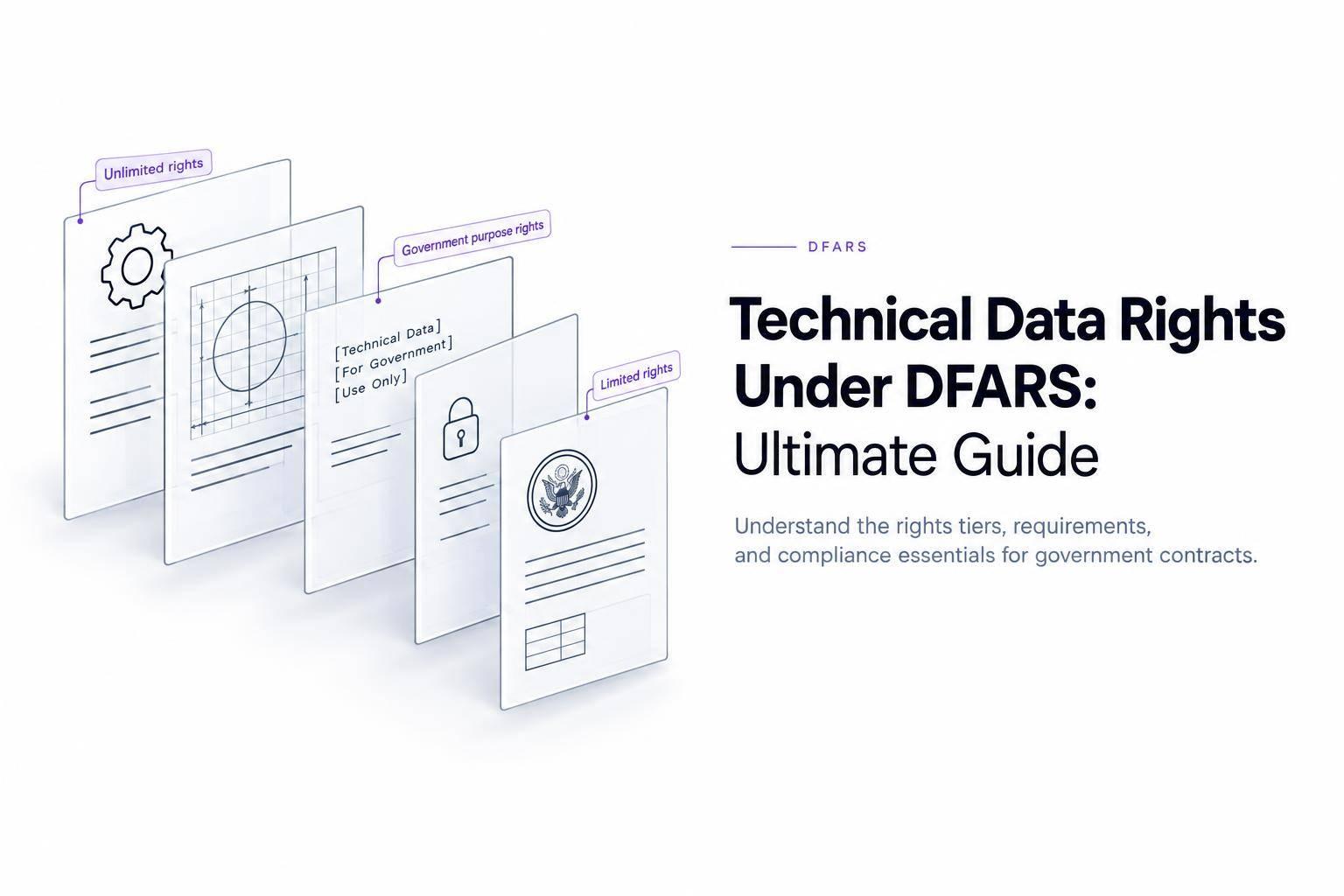
Delivering technical data does not automatically give the Government unlimited rights. I start with three separate questions: Who owns it, what license does the Government receive, and what must you deliver?
Under DFARS 252.227-7013, development funding generally sets the default rights: private funding means limited rights, mixed funding means Government purpose rights, and Government funding means unlimited rights. Exceptions and the contract’s clause edition still control. Government purpose rights usually convert to unlimited rights after five years.
In this guide, I explain how to:
- Match technical data, software, commercial material, and SBIR/STTR work to the right clauses.
- Support restrictions with funding records, assertions, and required legends.
- Align supplier agreements with delivery requirements.
- Track correction deadlines, answer Government challenges, and maintain a rights register.
- Use automation to organize records while keeping rights decisions under human review.
My starting rule: <u>check the clause, funding records, and markings before you submit or deliver.</u>
DFARS Data Rights: Challenge and Response Process
2. Determine Funding and Government License Rights
Apply the Development Funding Test
Trace development funding to the lowest segregable item, component, process, or software module. For data describing an item, review how that item was developed. For data unrelated to an item, component, or process, review how the data itself was created. Keep development costs separate from later drawing preparation or formatting costs.
| Development funding | Default -7013 rights | Key exceptions | Supporting records |
|---|---|---|---|
| Exclusively Government-funded | Unlimited rights | Verify that direct Government charges funded the relevant development – not just data delivery | Contract work statements, project ledgers, timecards |
| Exclusively privately funded | Limited rights | Qualifying indirect development costs, including IR&D, count as private expense; unlimited-rights categories can override this default | IR&D accounts, private investment records, engineering reports |
| Mixed Government and private funding | Government purpose rights | Apply the relevant development boundary, exceptions, and negotiated terms | Segregated charge codes, cost allocations, work authorizations, development schedules |
Funding establishes the default. The license category then determines how the Government may use and disclose the material, and how long those rights last.
Compare Government License Categories
Use the funding result to identify the default license category.
| License category | Information type | Permitted uses | Disclosure limits | Duration and exceptions |
|---|---|---|---|---|
| Unlimited rights | Government-funded technical data and other qualifying categories; software or documentation after applicable restricted periods | Use, modify, reproduce, disclose, and authorize others to do so | No contractor-imposed restriction under this license | Generally perpetual; the applicable clause controls |
| Government purpose rights | Mixed-funded technical data or software covered by the applicable clause | Use, modify, reproduce, perform, display, and disclose for Government purposes, including competitive procurement | Limited to Government purposes and authorized recipients | Usually five years under -7013 or -7014, or another negotiated period; then converts to unlimited rights |
| Limited rights | Privately developed technical data concerning noncommercial items, components, or processes | Specified Government uses | Outside disclosure restricted, subject to clause exceptions | Generally continues under the applicable license; restrictions require a valid assertion and proper legend |
| Restricted rights | Privately developed other-than-commercial computer software | Limited internal Government use | Copying, modification, disclosure, and contractor use constrained by -7014 | The governing license and clause control; these are not limited rights in technical data |
| Negotiated license | Data or software with negotiated rights | Defined by the negotiated license | Contract-specific | Document the terms expressly; a Government purpose rights period may be changed before delivery without consideration from either party |
Check -7013’s separate unlimited-rights categories, too. These include qualifying publicly available or otherwise unrestricted data, plus data needed for operation, maintenance, installation, or training. That last category excludes detailed manufacturing or process data, though another unlimited-rights category may still apply.
The default five-year Government purpose rights period starts when the development-bearing contract, subcontract, letter contract, modification, or option is executed – not when material is delivered or invoiced. The parties may negotiate a different period or change it before delivery without consideration from either party. Record the triggering instrument, execution date, covered data, and conversion date. When the period expires, the Government receives unlimited rights.
Apply Software, Commercial, and SBIR/STTR Rules
Do not apply -7013 rights to every deliverable. Software follows the same default-rights logic, but separate clause rules apply. Under -7014, distinguish source code, object code, executable code, and software documentation because their rights can differ. Embedded code is still software, even when it sits inside hardware.
Commercial software and documentation generally follow the applicable commercial license terms. Commercial technical data generally follow -7015, while Government-funded portions need separate review. Check third-party software licenses and obtain any required Government license or written contracting-officer approval.
For SBIR/STTR material, apply the relevant -7018 framework. The clause generally provides protection from the award date through 20 years after that date, unless another period is negotiated. Rights after protection ends depend on how the clause treats the data.
Use these determinations when preparing legends, assertions, and delivery records.
sbb-itb-bb3960c
3. Align Assertions, Deliverables, and Flow-Downs
Prepare the Pre-Award Assertion Schedule
Once funding determines the default rights, carry those results into the assertion schedule, delivery list, and subcontract flow-downs.
Attach the DFARS 252.227-7017 assertion schedule to the offer. It must be dated and signed by an authorized representative. For each restricted deliverable, list the assertion basis, corresponding rights category, and asserting party. Use precise identifiers, and add CDRL references and evidence locations to the internal register.
Combine supplier submissions without replacing specific claims with blanket proprietary statements. An assertion records a claim; it does not prove entitlement.
Check the schedule against supplier licenses, technical descriptions, and proposed deliverables. After award, route omissions, corrections, and newly discovered restrictions through the contracting officer under the contract procedures. Record the discovery date, reason, affected file version, evidence, and required approval. Do not quietly add restrictions to deliveries or assume late assertions change rights already granted.
Match Delivery Requirements and Restrictive Legends
Use the approved assertion record to guide every CDRL entry, legend, and transmittal.
Create a crosswalk that links each CDRL entry to its deliverable, supplier, applicable rights clause, assertion, required legend, format, recipient, and due date. Include required flow-downs, assertion deadlines, marking instructions, and required records in subcontracts and purchase orders.
For technical data relating to commercial products and commercial services, DFARS 252.227-7015 requires inserting the clause in applicable subcontracts, changing only party names, and requiring suppliers to do the same.
Before release, check documents, electronic files, and metadata against the crosswalk and matching legend. A generic proprietary notice cannot replace the required DFARS legend.
Different marking problems follow different correction rules:
- Omitted or incorrect markings: Under DFARS 252.227-7013, correction requests generally must reach the contracting officer within six months after delivery, unless an extension is approved.
- Unauthorized or nonconforming legends: Generally, contractors have 60 days to correct them after receiving returned data or the applicable notice. Otherwise, the Government may correct or remove them at the contractor’s expense.
- Unsupported restrictions: Follow the applicable validation and correction procedures. Replacing the legend alone is not enough.
Record the affected file version, notice date, deadline, approved correction, and redelivery.
Assign Compliance Owners and Review Dates
Assign a review date and backup owner for each deadline in the contract calendar.
| Control | Owner | Review timing | Supporting records | Corrective action |
|---|---|---|---|---|
| Assertions and proposal consistency | Proposal team with contracts | Before submission; after amendments | Signed -7017 schedule, supplier assertions, proposal | Resolve missing items and conflicts |
| Funding support | Engineering and finance | Before assertion approval; after material changes | Development history, accounting records, evidence index | Obtain evidence or narrow claims |
| Supplier flow-downs | Subcontract manager | Before subcontract award; at modifications | Subcontracts, purchase orders, licenses, assertions | Correct clauses and instructions |
| Delivery alignment | Data manager or contracts administrator | Before each delivery | CDRL crosswalk, transmittal | Correct the version, recipient, format, or clause |
| Markings and release | Authorized reviewer with technical and contracts input | Before release; upon correction notice | Legend, final file, checklist, notice log | Hold release; correct and document redelivery |
If a marking is challenged, log the notice immediately and add the applicable response deadline to the calendar.
4. Respond to Government Challenges
If the Government questions a restriction, respond using the existing assertion record, legend, and delivery file.
Track Challenge and Response Deadlines
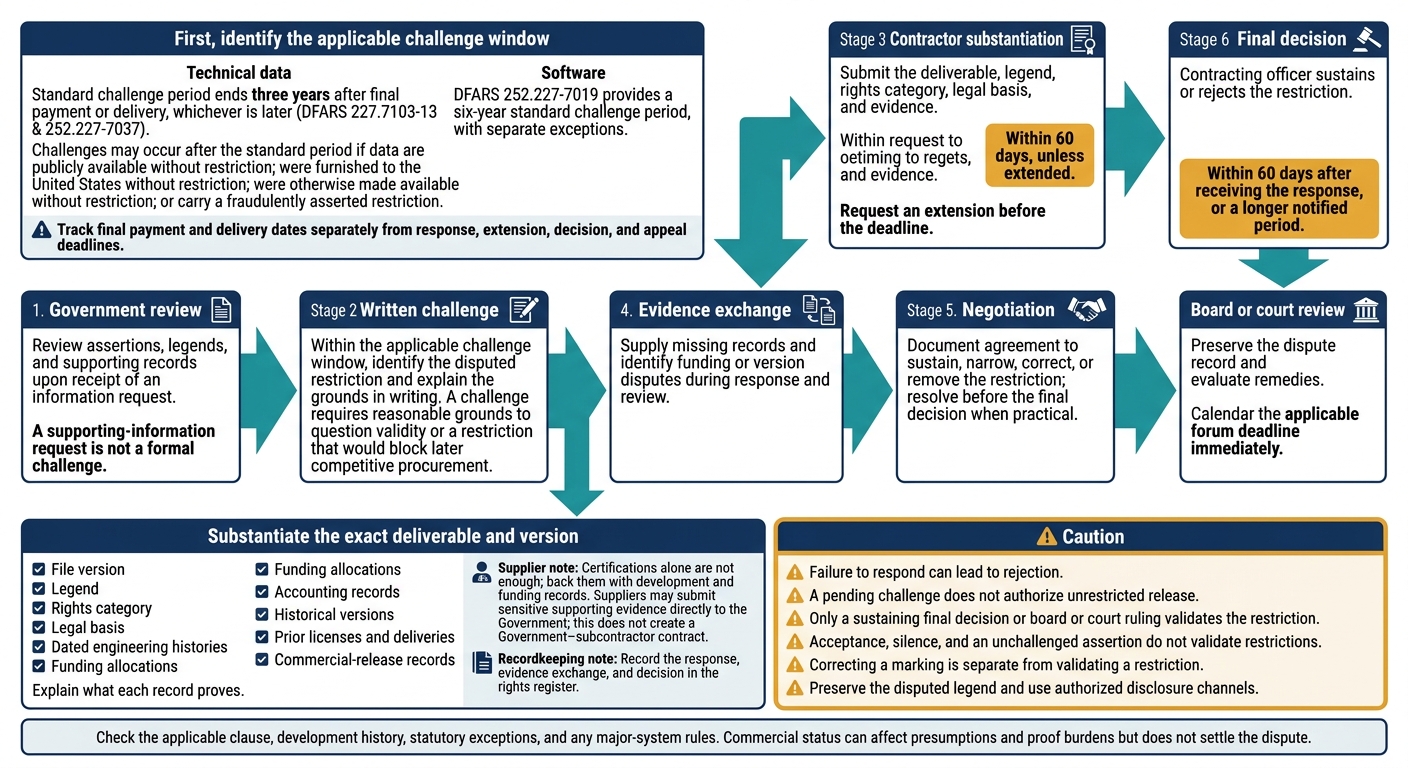
For technical data, the standard challenge period ends three years after final payment or delivery, whichever is later, under DFARS 227.7103-13 and 252.227-7037. For software, DFARS 252.227-7019 sets a six-year standard challenge period with separate exceptions.
The Government may challenge technical-data restrictions after that period if the data:
- Are publicly available without restriction;
- Were furnished to the United States without restriction;
- Were otherwise made available without restriction; or
- Carry a fraudulently asserted restriction.
Track final payment and delivery dates separately from response, extension, decision, and appeal deadlines. Commercial status can change presumptions and proof burdens, but it does not settle the dispute. Check the applicable clause, development history, statutory exceptions, and any major-system rules that affect proof or challenges.
With those dates recorded, follow the written challenge and response process below.
Follow the Challenge and Appeal Process
A supporting-information request is not a formal challenge. Check whether the notice invokes formal challenge procedures. A written challenge must identify the disputed restriction and explain why it is disputed. The Government may issue a challenge only when reasonable grounds exist to question the restriction’s validity or when the restriction would block later competitive procurement.
| Stage | Required action | Timing |
|---|---|---|
| Government review | Review assertions, legends, and supporting records. | On receipt of an information request |
| Written challenge | Identify the restriction and grounds in writing. | Within the applicable challenge window |
| Contractor substantiation | Submit the deliverable, legend, rights category, legal basis, and evidence. | Within 60 days, unless extended; request an extension before the deadline |
| Evidence exchange | Supply missing records and identify funding or version disputes. | During response and review |
| Negotiation | Document agreement to sustain, narrow, correct, or remove the restriction. | Before the final decision when practical |
| Final decision | Contracting officer sustains or rejects the restriction. | Within 60 days after receiving the response, or a longer notified period |
| Board or court review | Preserve the dispute record and evaluate remedies. | Calendar the applicable forum deadline immediately |
Failure to respond can lead to rejection. A pending challenge does not authorize unrestricted release; only a sustaining final decision or board or court ruling validates the restriction. Preserve the disputed legend and use authorized disclosure channels under the applicable procedures.
Acceptance, silence, and an unchallenged assertion do not validate restrictions. Correcting a marking is separate from validating a restriction. An unjustified legend may ultimately be removed at the contractor’s expense.
Build Evidence for Each Restriction
Base the response on evidence for the specific deliverable – not general supplier statements.
- Build an evidence file for the exact version at issue. Connect the file version, legend, and rights category to the asserted restriction. Include dated engineering histories, funding allocations, accounting records, historical versions, prior licenses and deliveries, and commercial-release records. Explain what each record proves.
- Back supplier certifications with development and funding records. Certifications alone are not enough. Allow suppliers to submit supporting evidence directly to the Government when needed to protect sensitive records. These direct dealings do not create a contract between the Government and the subcontractor.
- Record the response, evidence exchange, and decision in the rights register.
5. Conclusion: Keep Records and Check Compliance
Maintain a Controlled Data-Rights Register
Assign an owner to each contract’s register and name reviewers from engineering, finance, contracts, procurement, security, and legal. Link every item to its classification, clause, funding evidence, assertion, license, version, legend, flow-down, delivery status, and challenge history.
Keep delivery, acceptance, license, and challenge records through the final decision. The register should serve as the evidence file for any challenge.
Control access and set retention rules. Follow contract requirements, FAR recordkeeping rules, license restrictions, and legal holds when deciding what to dispose of and when. Review the register quarterly, after modifications or new releases, and at closeout.
Use Proposal Automation With Human Review
Narwin.ai can help analyze solicitations and draft proposals, but it does not validate technical-data rights. Use automation to organize records – not decide rights.
Human reviewers must verify classification and version, segregated development funding, clause mapping and flow-downs, supplier assertions, and disputed rights. Complete security, confidentiality, and export-control reviews before uploading. Do not upload CUI, export-controlled data, or classified information without the required review.
Run Pre-Submission and Post-Award Checks
Use the register to guide the last compliance check.
Before submission:
- Verify clauses, CDRLs, and special license terms.
- Confirm classification and funding support.
- Reconcile supplier assertions with deliverables and proposal volumes.
- Confirm required flow-downs for subcontract awards.
- Ensure engineering, finance, contracts, procurement, security, and legal have reviewed automation output.
After award:
- Verify required flow-downs and each delivery’s version and authorized legend.
- Record negotiated license terms and Government purpose rights expiration dates.
- Retain delivery, acceptance, and rights-support records.
- Assign challenge-response ownership and make rights review a delivery gate – not just a proposal task.
FAQs
How do later upgrades affect my original data rights?
Upgrades or modifications can affect your data rights. Those rights depend on the specific item and how it was developed, so check each change against the governing clause and the basis for your rights assertion [1].
Keep clear version histories and complete contract records that link each modification to the rights you assert. Without these records, you risk losing contract-level recognition of those rights or having trouble defending your markings if challenged [1][2].
What if a supplier cannot substantiate its restrictions?
Restrictions without support may be rejected during evaluation, negotiation, administration, or later challenges. This can weaken proprietary protections and affect pricing assumptions [1].
Don’t fill in missing assertions. Document gaps and refer them to contracts counsel before submission to avoid an incomplete or unsupported DFARS 252.227-7017 disclosure [1][2]. Keep supporting evidence for every restricted item. If that proof cannot be produced when requested, treat the gap as a bid blocker [1][3].
How should I mark deliverables containing both software and technical data?
Do not use the same generic proprietary stamp for both categories. For noncommercial items, use the technical data legends required by DFARS 252.227-7013 and the computer software legend specified in DFARS 252.227-7014 [1].
Match each deliverable to the clause that governs it in the solicitation. Then apply the exact legend authorized for that category. Mixing up the categories can lead to loss of rights or rejection of restrictive markings [1].